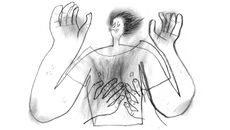
Wilhemina
MY HUSBAND AND I ONLY SPEAK ON THE INTERNET
Dear Wilhemina
My husband and I now only communicate via Twitter, Facebook and email. At first the fad seemed a powerful antidote to the need to deal with work emails late at night. But slowly we got more interested in expanding our numbers of friends and reporting on the moment rather than being in it. As virtual sex seems a long way off I hope you have some suggestions.
Read more »
Lucy Wadham
France’s hapless former prime minister, Dominique de Villepin, once told a Le Figaro journalist that what France really wanted was to be raped by a strong leader. “La France veut qu’on la prenne,” said the suave diplomat: France wants to be taken by force. While Villepin’s record for taking his nation’s temperature is pretty poor, it seems that on the matter of France’s deepest desires, he was probably right.
In some ways, Nicolas Sarkozy’s strategy—or posture—was to “take France by force.” His presidential campaign was peppered with pugnacious, coercive vocabulary. He claimed to be answering what he called the nation’s long-suppressed “need for order, authority and firmness.” Distinguishing himself from the motherly, reassuring messages of his opponent, Ségolène Royal, he invited citizens to vote for la rupture.
Read more »
Mark Cousins
For about a week, at the time of writing, double-decker buses around Britain have been emblazoned with adverts for the new American comedy film Zack and Miri Make a Porno (pictured, below right). The film’s title is written in bold, orange-yellow capital letters almost a metre high, like you’d see at a funfair. The word “PORNO” is particularly large. The typeface is similar to that used for Toy Story.
In the US, the film’s posters feature black and white stick drawings. The words “make a porno” are printed in a thin, serifed typeface, rather smaller than the words “Zack and Miri.” The producers, the Weinstein Company, who greenlit the movie on the basis of its title alone (according to Entertainment Weekly), originally submitted the “funfair” branding to the Motion Picture Association of America for approval, but were knocked back, so came up with the more discreet version.
Never before in my lifetime has the word “porno” been so present in the space that I share with my fellow city dwellers. Never before has the word been presented in such a friendly way. Never before has it been so close to the graphics of childhood pleasure. As you can probably tell, I am angry. But have I the right to be?
By living close to people unlike myself, I inevitably expect to see messages of which I disapprove. A guy has just come into the café where I am writing this wearing a T-shirt that says “Nice Legs. When Do They Open?” which, for me, chills the air for a moment. Every few years, the Orange Order marches through a park near me banging its drums. I do not claim the right to be consulted about such things. Nor am I angry at what some call the growing sexualisation of western society. This is far too vague a phrase. I would not object if the buses carried images of naked people, though I reserve the right to do so if the poses of the bodies or the semantics of the image were degrading. No, it’s the word PORNO on buses that’s got my goat. Especially as it’s in the service of a medium—film—on which I dote.
Read more »
Jonathan Derbyshire
The Act of Love
by Howard Jacobson (Jonathan Cape, £17.99)
Felix Quinn, the narrator of Howard Jacobson’s new novel, is “afflicted” by love. He is a connoisseur of its “agonies,” a veteran of “sexual insult.” The Act of Love is irrigated by Felix’s obsession with “that category of classic novel… whose subject is humiliation.”
This is familiar territory for Jacobson. Writing in Prospect earlier this year, he warned that “you can’t mess around with sex, in life or literature. It is never not serious.” Especially not in literature, you can imagine him wanting to add—and certainly not in his own fiction, which combines extravagant comic energy with a distinctive kind of erotic gravitas. Sex is a serious business for the characters in all Jacobson’s novels—or all of the male characters, at least. They pursue their affairs sedulously, even grimly, and their virility is frequently put in the service of their rage or despair.
Read more »
Howard Jacobson
Discuss this article on First Drafts, Prospect’s blog
“The first thing you should know is that I’m a whore.”
Belle de Jour: The Intimate Adventures of a London Call Girl (Phoenix)
“A field study in nine countries showed that between 60 and 75 per cent of women in prostitution had been raped, between 70 and 95 per cent had been physically assaulted, and 68 per cent displayed symptoms of post-traumatic stress disorder in the same range as combat veterans and victims of torture.”
Joan Smith, The Independent, 27th December 2007
“Another thing that distinguishes a ladylike working girl is her groomed and tidy muff. Clients know you make your money with your pussy, but a freshly waxed, beautifully maintained pussy sends a message: You spend money on your pussy.”
Tracy Quan, Diary of a Manhattan Call Girl (HarperPerennial)
Read more »
Fiona Mactaggart
YES
Fiona Mactaggart
NO
Julia O’Connell Davidson
Dear Professor O’Connell Davidson
10th February 2008
Read more »
Mark Cousins
The city in which I live, Edinburgh, hasn’t exactly been neglected by writers and filmmakers. Stroll its streets and you can see how it inspired the gothic dualism of Doctor Jekyll and Mr Hyde. Go to a pub in its port, Leith, and you find yourself drinking beside characters from Trainspotting. It’s the “fur coat, nae knickers” town; it’s “auld reekie” because its 19th-century smoke made the place stink; it’s the Athens of the north; the place of innumerable literary flytings; the city where Jean Brodie told her girrrls that they were in their prrrrime; it’s the place where Ian Rankin’s Rebus threads through his labyrinth of booze.
Despite such over-determination, the capital of Scotland has never really been eroticised. Until now, that is. David Mackenzie’s new film Hallam Foe, from a book by Peter Jinks, turns Edinburgh into a Hitchcockian world of lustful observation. Just as in Vertigo, James Stewart meets a woman who resembles his apparently dead lover, and tries to turn the former into the latter, to increase, or return to, his erotic charge; so in Hallam Foe, Jamie Bell meets a woman who resembles his dead mother, spies on her having sex and, unable to help himself, partakes in scenarios in which the woman and his memories of his mother merge.
This sounds deadeningly Oedipal, but Mackenzie’s are the most erotic British films of our time. Whereas in France, directors who are interested in sexuality are a dime a dozen, in Britain they are almost unique. Mackenzie’s previous films (Asylum, Young Adam) have all been structured around sex scenes. In The Last Great Wilderness, there’s a great line where the lead character confesses that he washed his “nob” because he was meeting a girl. Hallam Foe is Mackenzie’s best movie yet, because it marries eros with the wholly cinematic situation found in Jinks’s book. Hallam moves to Edinburgh, has nowhere to live and so, like a birdman, ends up kipping in rooftop spaces and spending much of the film obsessively watching his female boss, like Jimmy Stewart in another Hitchcock film, Rear Window.
Read more »
Katherine Angel
It was circumstance that led Johan Rizki, a French-American investor, to locate Amora, his “Academy of Sex and Relationships,” in London. But it’s a choice he feels confident about. The British, he says, are not prudish—they’re progressive, keen to learn and open to self-improvement. This remark stayed with me as I wandered around Amora, reading about foreplay etiquette, feeling a variety of dildos, designing my perfect partner on an interactive screen and prodding a plastic model in order to learn about erogenous zones. Confusingly, the lucky man’s inner arm lit up in response to my efforts, but his flaccid penis did not.
Plastic models abound at Amora, but in the words of Sarah Brewer, director of exhibits, “there are no mothy, musty waxworks.” Amora is not, its promotional material assures us, a “sex museum.” So what is it? The centre, which opened earlier this year, aims to be a sensual experience that will make “your world a sexier place.” It also wants to provide responsible information on what people do, and how. There was a need, felt Rizki, for something located between the “sleazy, seedy” world of pornography and the “dull” world of sex education. Amora is indeed unique in that it contains in one space elements usually kept separate: the realm of the sexual health clinic, and that of sexual exploration and kinkiness. But aside from this, it is a disappointment. It does not represent a “bold new departure”; and it is, in fact, distinctly unerotic.
Situated in the Trocadero, close to London’s Piccadilly, Amora’s interior is very pink. With swirling floral designs, vaguely ambient music and a distinctly heterosexual focus, it feels like the pages of Cosmo magazine brought to life. With the help of video screens, visitors are taught how to undress sexily, give massages and play erotic food games. Handy hints are proffered: when it comes to oral sex, “you’ve got to give it to get it, so be generous in lavishing your lover with oral treats and they’ll be more inclined to return the favour.” A formidable array of sex toys are on view. Cross-sectioned plastic models encourage you to insert your finger in order to locate the prostate gland and the G-spot; my explorations gratifyingly elicited a manly “Oh yes!” and a breathless “Oh! That’s it!” In the “Fantasy and Fetish” room, you are given a paddle with which to spank the long-suffering plastic models, bent over obligingly. The last section, entitled “Wellbeing,” is a forbidding trundle through an STD “wheel of fate,” information on erectile dysfunction, vaginal discharge, painful sex, fertility, and a finger-wagging section on drugs and alcohol. Then out you pop into the lounge and bar, from where the (overpriced) boutique beckons.
Read more »
Arabella Weir
So, I have a confession to make. You’ll be thrilled to learn it’s not a faux-cute, self-consciously winsome revelation such as, “I secretly love Britain’s Got Talent,” or, “I just can’t stop eating chocolate eclairs.” Or like when someone is replying to a question posed to reveal something unknown about them, like, “What do you least like about yourself?” and says, most infuriatingly, something along the lines of, “I can’t say no,” or, “I’m too kind to people who ask me to do stuff.” That’s not a confession, you twat. You’re supposed to tell us something genuinely unpleasant about yourself, like, “I always shout out the wrong name when I climax,” or, “I deliver promotional leaflets for the BNP.”
So, having identified what a real confession should be, I am grasping the nettle with brio and making one that is pretty unedifying and casts me in a fairly unappealing light. All that a confession should be. Here it is.
I really fancy my neighbour’s 17-year-old son. This may not seem like much of a revelation, but it is, trust me. I don’t just fancy him; I positively lust after him, as if I were what used to be known as a dirty old man. I blush when he glances at me. In keeping with most of his age group, he’s a wannabe rock star, so I caught myself letting him know that I know someone from the Clash. And it was worth it—he gazed open-mouthed at me with real admiration. It might not have been sexual, but it was a long gaze and I’m not about to split hairs. I make efforts to make conversation with him, and I’ve never done that, not with any boys—ever, not even when I cared. I’m 49. I stopped being entitled even to look at teenage boys (except to reprimand them for antisocial behaviour at a bus stop), never mind fancy them, aeons ago. I stopped fancying everyone aeons ago. Sure, I can appreciate a fit boy as much as the next guy, or girl, but all that falling madly in love with people based on nothing more than what they look like in a pair of jeans left me way back. Nowadays I see an attractive man and think, “He’s good-looking, I guess,” and that’s about it. I don’t actively fancy them. If you want proof of this assertion—and proof does not come more rock solid than this—consider this. I recently went into the new Abercrombie & Fitch shop in the west end. The main door was manned by four boys wearing jeans and nothing else, not even socks. Their torsos looked as if they’d been hewn out of soap, but what did I do? I laughed. Ha! That’s how impervious I am these days to tasty boys. So you’ll appreciate how surprised I am to find I can’t look at my pal’s son without coming over all peculiar.
Read more »
Frederic Raphael
Nicole Kidman by David Thomson
(Bloomsbury, £18.99)
The critic’s first duty is to seek out anything meritorious and commend it. In the case of David Thomson’s Nicole Kidman, this will not detain us long. There are some nice pics of the lady and hints of intelligent things the author might have said about the medium, if he had not been infatuated to a point beyond that which reduced Emil Jannings, in The Blue Angel, from presiding professor to drooling dupe.
The film critic is forever pressing his nose—and other parts, it seems—against the barrier between him and the medium. How touchingly often he will tell you of his meetings with the famous, who treated him as at least an equal. Every tradesman likes to imagine himself welcome at the front door. Thomson hurries to recount how he actually held hands with Tuesday Weld after she had failed to set the world on fire. He also sat on the kerb with Katie Hepburn, the most loved woman in America, while a tyre got changed. This news is made relevant to Nicole Kidman because, Thomson says here, she “often invokes Hepburn as her idol or model.” Often? Daily? Monthly? And model for what? Kidman doesn’t have a recognisable style of delivering a line and la Hepburn never flashed her ass, as Nicole—we’re all pals here, right?—first did in Dead Calm. In The Blue Room, Thomson also glimpsed Nic’s “gingery pubic hair” when she stripped, very briefly, for theatre buffs. (Hey, wasn’t Katie called “Red” by Cary in The Philadelphia Story?) If accuracy matters, the parcel passed round the ring in Schnitzler’s original Reigen was not “physical love,” as Thomson has it, but syphilis.
Read more »